

During the mid-nineteenth century, several ambitious projects constituted a complete rethinking of how Portland's waterfront could support commercial growth. Taking advantage of the port's year round ice-free harbor and the city's strong trade relati...
Phoenix Park, rededicated Lincoln Park in 1909 as shown on this map [51], was the city's first formal park. It was built as a fire break after the great fire in the midst of what was then one of the city's densest neighborhoods. The park featured a c...

Portland changed dramatically overnight as a result of the Great Fire of July 4, 1866. The winds were high and the tide was out when the fire began, thus creating ideal conditions for the fire to spread from west to east, devastating much of the city...

These three maps [16, 17, 18] were produced as fold-outs to be inserted in Portland city directories first published in 1823. The first map in this series [16], produced by Abel Bowen, became the benchmark against which future directory maps were mea...
The shape of Portland's peninsula changed dramatically over the past two hundred years as its shoreline was repeatedly reconfigured by in-filling. These composite maps, created by Rosemary Mosher with Geographic Information Systems (GIS) technology, ...
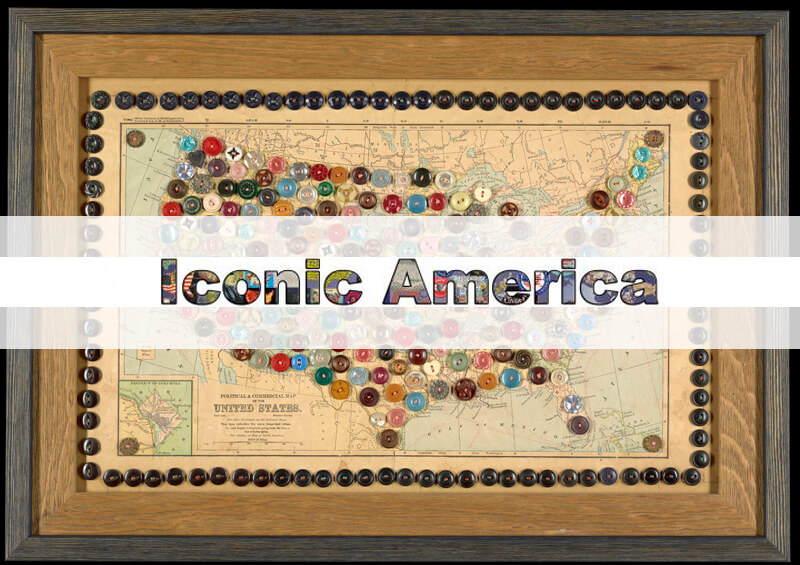
September 11, 2012 ~ February 28, 2013 ... Highlights from the Fondersmith Collection of Cartographic Ephemera John Fondersmith, guest curator The symbolic use in modern American culture of the outline map of the United States of America is so wi...

In addition to sparkling gas stations, happy traveling families, and majestic natural scenery, oil companies also portrayed the darker side of American history by including images of war. The military conflicts that most often appeared in cover art w...
By the late 1920’s over half of American families owned or had access to an automobile. With nearly 10 million cars on the road, thousands of gas stations began to dot the landscape. Attempting to make the gas station as more than merely as place t...
With the rising prosperity of the mid-twentieth century, the automobile became a staple for many American families. Responding to this shift, oil companies began marketing the American landscape as something an adventurous family should experience. R...
New England Regional ImageryNew England was one of the landscapes that road map art helped to popularize with the traveling family. The region was depicted as a welcoming place, attractive for both its rugged natural features and its quaint, rustic t...

